
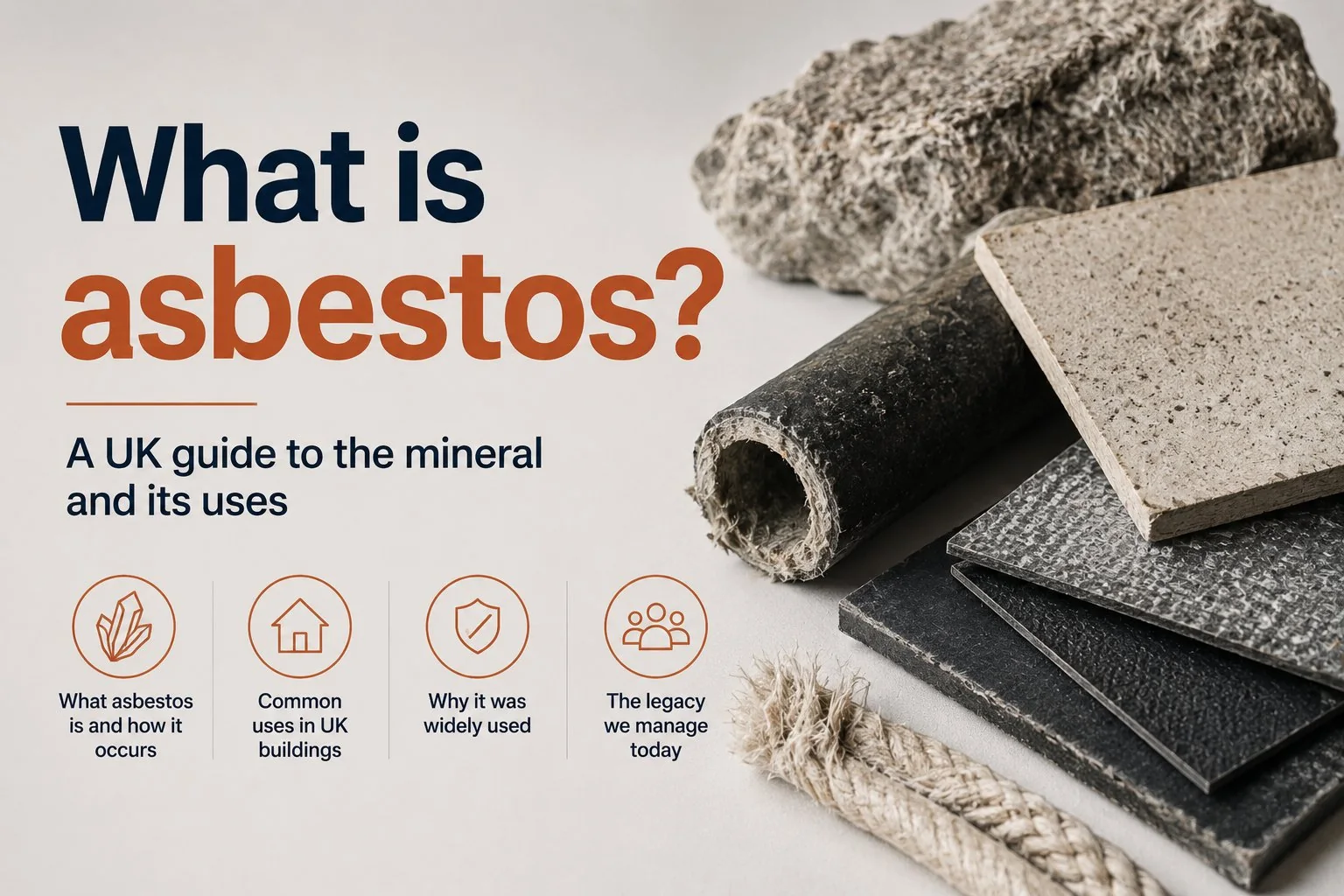
Asbestos is the generic commercial name for a group of six naturally occurring fibrous silicate minerals. The name covers two different mineral families — one curly, one straight-fibred — but they share three qualities that made them industrially valuable for most of the twentieth century: they resist heat, they resist chemical attack, and their fibres are mechanically strong.
Asbestos fibres can be inhaled when materials release them, and disease may appear decades later. HSE estimates around 5,000 asbestos-related deaths a year in Great Britain. New use was prohibited in stages; existing materials can remain and need appropriate management.
This page covers what asbestos actually is — at the level of the rock it comes from and the products it ended up in — without going into the disease detail covered elsewhere on this site.
The two mineral groups
Asbestos isn’t one substance. It’s a category that covers six different silicate minerals from two distinct mineral families.
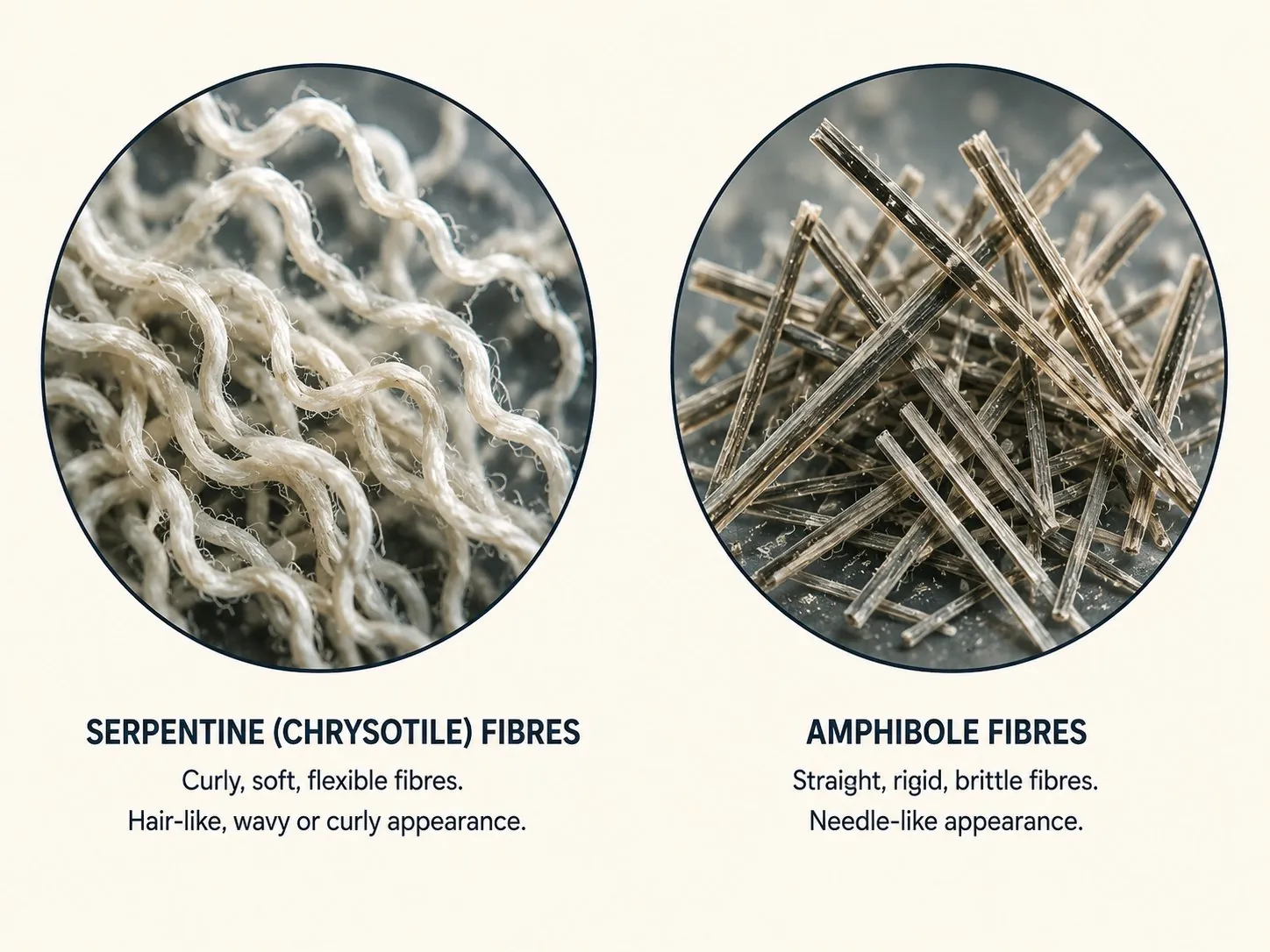
Serpentine asbestos contains one type — chrysotile. It’s the most widely used asbestos globally and accounts for most of the asbestos in UK buildings. The fibres are curly, soft, and flexible, which is why chrysotile could be spun and woven like cotton fibre.
Amphibole asbestos contains the other five types — amosite, crocidolite, tremolite, actinolite, and anthophyllite. The fibres are straight, rigid, and needle-like rather than curly. Amosite and crocidolite were used commercially on a substantial scale. The other three were used in only small quantities, and more often appear as natural contaminants of other minerals like talc and vermiculite than as deliberate ingredients.
Fibre type affects biological behaviour, but all forms of asbestos are carcinogenic. Differences between fibres do not make chrysotile safe or allow visual inspection to determine the precautions for a task.
Our guide to the types of asbestos covers the six minerals in detail.
Where asbestos comes from
Asbestos occurs as fibrous crystals in certain rocks. Commercial production separates the fibres from mined material; it is a naturally occurring mineral rather than a manufactured synthetic fibre.
Historically, the main producing countries were:
- Canada — a major historical chrysotile producer
- Russia and the former Soviet Union — major historical producers; Russia remains a current producer
- South Africa — a historical source of amosite and crocidolite
- Australia — a historical source, including crocidolite at Wittenoom
- China, Kazakhstan and Brazil — listed with Russia in USGS estimates of world asbestos mine production for 2025
Britain relied heavily on imported asbestos for construction, manufacturing and other uses. The legacy is the material that remains in older buildings and equipment; an import total does not measure how much remains today.
Why asbestos was used industrially
Setting aside the disease history for a moment, asbestos was an exceptionally useful material. The properties that drove industrial adoption from the late nineteenth century through to the late twentieth were:
Heat resistance. Asbestos fibres don’t burn, don’t melt at ordinary fire temperatures, and conduct heat poorly. This made them ideal for fireproofing structural steel, insulating boilers and pipes, lining fire doors, and sealing high-temperature joints.
Chemical resistance varies by mineral and conditions. This property supported some industrial uses, but it does not mean every asbestos product resists every acid or chemical.
Mechanical strength. The fibres are strong in tension, which is why they were used as a reinforcing fibre in cement (asbestos cement) and in vinyl floor tiles. A few per cent of chrysotile dramatically improves the dimensional stability and impact resistance of either material.
Versatility of form. Asbestos could be spun, woven, mixed with cement, applied as a sprayed coating, made into rigid boards, or used as a loose insulation fill. Few alternative materials offered the same range of physical forms.
Cost and useful performance helped asbestos become widely adopted. Its health effects and the eventual restrictions changed the choice of materials.
Asbestos was used in a wide variety of building, industrial and consumer products. It should not be assumed absent merely because a product is outside the best-known examples.
What asbestos was used in
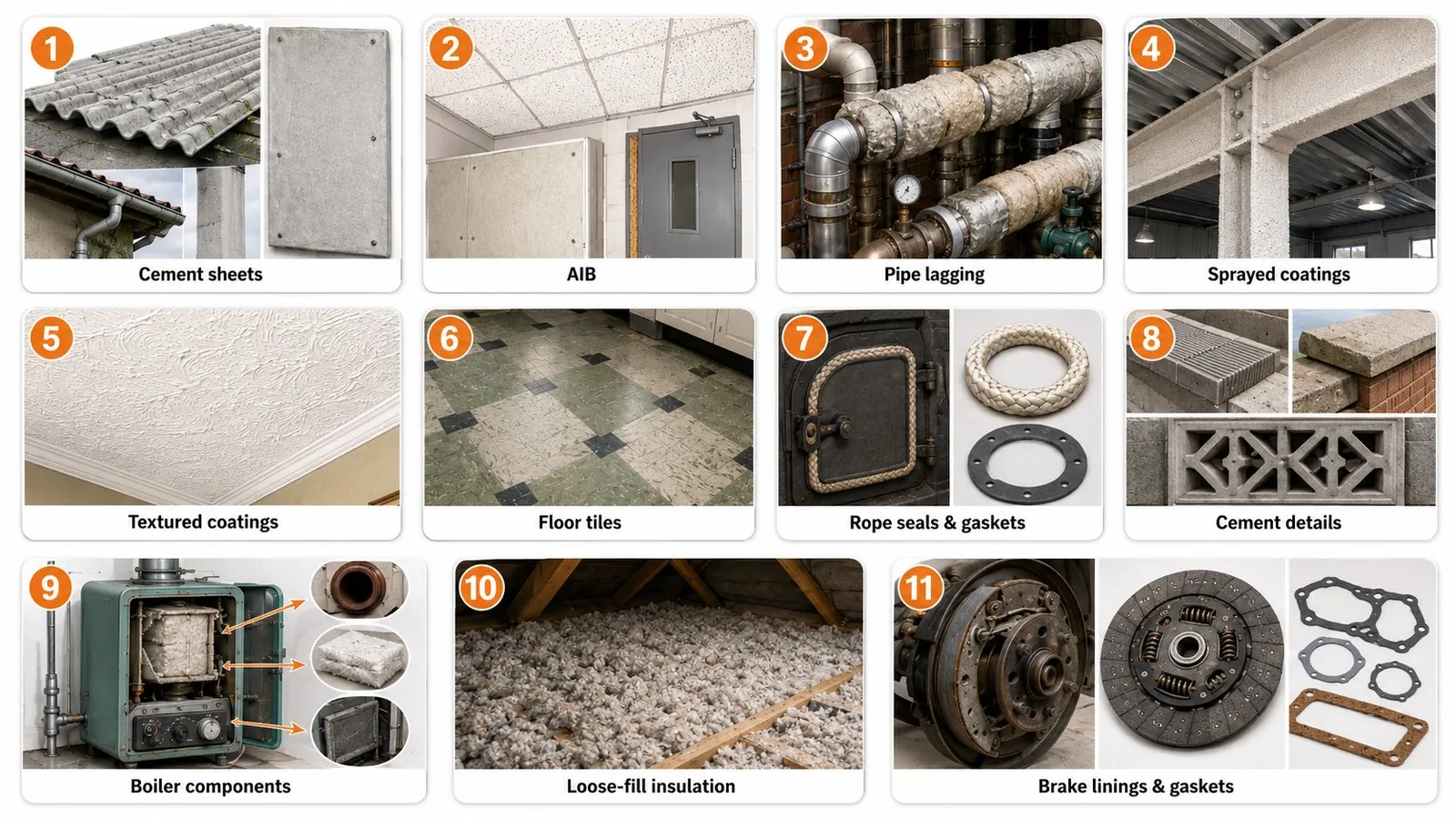
The applications most relevant to a UK reader are the construction-sector uses that still appear in pre-2000 buildings:
- Cement products — corrugated and flat sheets used for roofs, walls, soffits, gutters, downpipes, water tanks, and flue pipes
- Insulating board (AIB) — ceiling tiles, wall panels, fire-door cores, soffit panels, behind fire surrounds
- Pipe lagging — thermal insulation on heating pipes, calorifiers, and boilers in commercial and public buildings
- Sprayed coatings — applied to structural steel for fire protection in commercial buildings
- Textured decorative coatings — Artex and similar finishes on ceilings and walls
- Floor tiles — vinyl and thermoplastic tiles, with chrysotile bound into the matrix
- Rope seals and gaskets — around doors of stoves, boilers, and high-temperature equipment
- Cement-based products — including stair nosings, copings, and decorative panels
- Older boiler components — gaskets, insulation pads and linings; check the equipment and records rather than rely on one manufacture-year cut-off
- Loose-fill insulation — in lofts and cavity walls of some mid-century buildings
- Brake linings, clutch plates, and gaskets — in cars and industrial machinery
Other uses included heat-resistant textiles, electrical insulation and friction products. Historic manufacturing periods differ between products and cannot reliably identify a material on their own.
Our reference guide to asbestos-containing materials in UK buildings covers each category in more detail, including typical year ranges, locations, and risk classifications.
How asbestos becomes dangerous
Materials in good condition and unlikely to be disturbed can often be managed in place. Assess their condition and circumstances; “intact” is not a blanket guarantee that no fibres can ever be released.
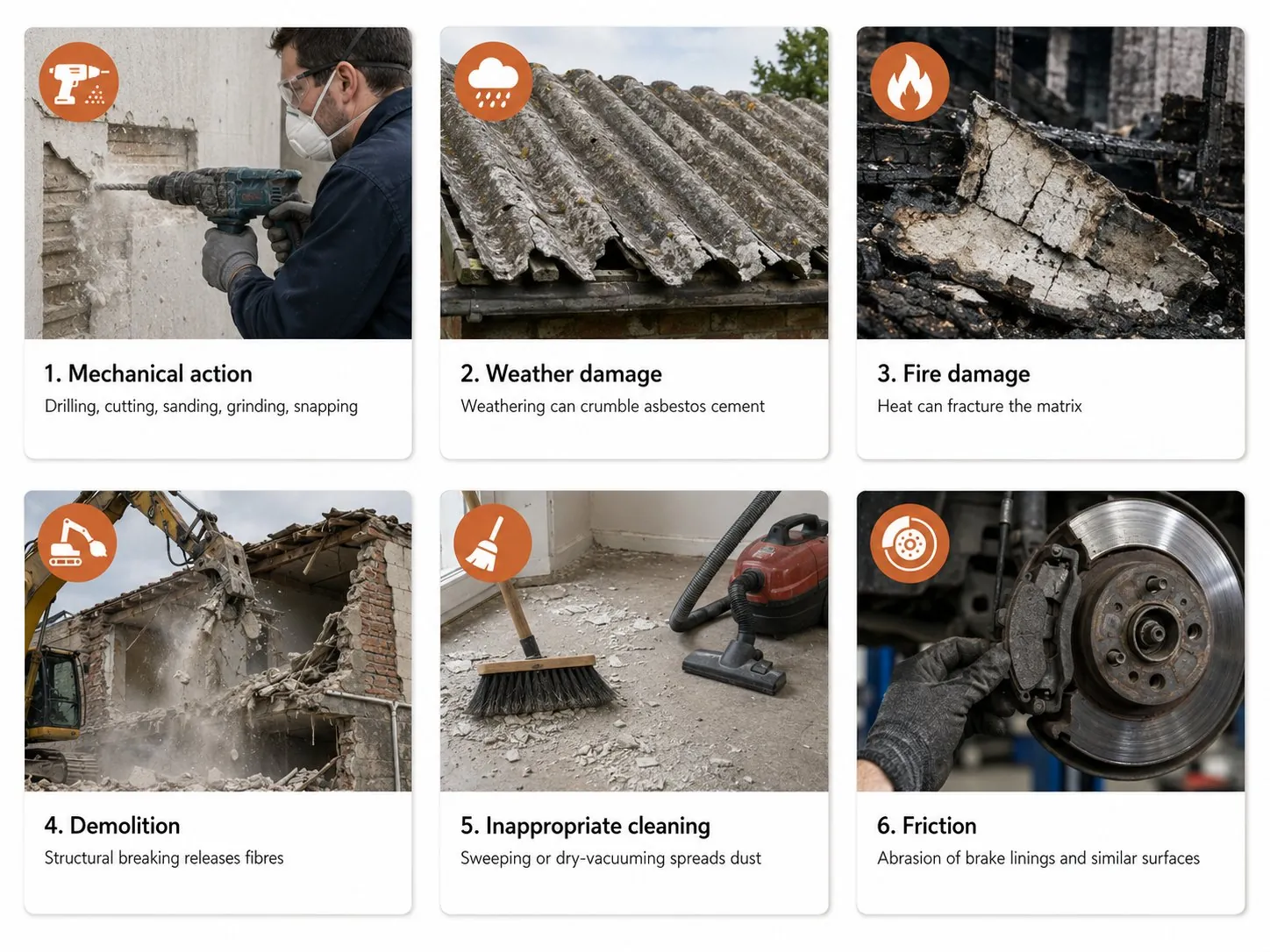
The danger comes when materials are damaged or worked on. Specifically:
- Mechanical action — drilling, cutting, sanding, grinding, snapping
- Weather damage — sustained weathering can crumble asbestos cement
- Fire damage — heat fractures the matrix and releases bound fibres
- Demolition — structural breaking inevitably releases fibres
- Inappropriate cleaning — sweeping or dry-vacuuming asbestos dust disperses it back into the air
- Friction — abrasion of brake linings and similar wear surfaces
Each of these activities can release fibres at concentrations far higher than ambient air, and inhaling those fibres is the route to disease. This is why the regulations focus heavily on identification before work, control measures during work, and proper containment of disturbed material.
The fibres themselves are small enough to bypass the upper airway’s defences. Once inhaled, they can lodge in the deep tissue of the lungs and the pleural lining, where they remain for decades. The body’s clearance mechanisms remove some — particularly chrysotile, with its curly fibre shape — but the fibres that remain can cause the chronic inflammation and cellular damage that eventually leads to mesothelioma, lung cancer, asbestosis, or pleural disease.
UK regulatory status today
Great Britain prohibited new chrysotile use from 24 November 1999, following earlier restrictions on other types. Northern Ireland’s corresponding chrysotile provisions took effect on 2 May 2000. Existing materials are a separate management issue.
The prohibitions did not require all existing asbestos to be removed. Great Britain’s CAR 2012 requires appropriate management and work precautions; Northern Ireland has separate regulations. Key duties include:
- Building owners and duty holders to manage asbestos in non-domestic premises (Regulation 4)
- Employers to identify asbestos before any work that might disturb it (Regulation 5)
- Employers to provide adequate training to workers who might be exposed (Regulation 10)
Asbestos is still mined in some countries. USGS’s 2026 summary lists Russia, China, Kazakhstan and Brazil in its 2025 world-production estimates; production, export and domestic-use rules are different questions.
HSE publishes Great Britain guidance, including HSG264 on surveys, HSG247 for licensed contractors and L143 on the regulations. Northern Ireland uses its separate legal and enforcement framework.
Frequently asked questions
Is asbestos man-made?
No. Asbestos is a group of naturally occurring silicate minerals that are mined from rock formations. The fibres form geologically; they aren’t synthesised.
Is asbestos magnetic?
A magnet is not a reliable identification test. Do not handle or disturb suspect material to test it; use competent assessment and appropriate laboratory analysis.
Is asbestos radioactive?
No. The hazards of asbestos are chemical and mechanical — the durability and shape of the fibres in lung tissue — not radioactive.
Where does asbestos come from?
Asbestos occurs in fibrous mineral deposits. Historical sources included Canada, South Africa and Australia; USGS’s 2025 production estimates list Russia, China, Kazakhstan and Brazil.
Is asbestos still mined today?
Yes. USGS estimates continuing production in Russia, China, Kazakhstan and Brazil for 2025. Its figures concern mining, not the separate question of which countries permit particular uses.
What’s the difference between asbestos and fibreglass?
Both are fibrous materials used for insulation, but they’re chemically and physically different. Fibreglass is man-made glass fibre; asbestos is a natural silicate mineral. Fibreglass fibres are generally larger and have different breakdown behaviour in the lung. The two materials are not interchangeable in regulatory terms — fibreglass is not asbestos and is not subject to asbestos regulations.
Why was asbestos used if it was known to be dangerous?
Understanding of asbestos disease and workplace controls developed over many decades. Long disease latency meant that illness continued to appear long after exposure; the prohibition dates do not mean earlier exposure was safe.
For the legal framework that now governs asbestos in the UK, see our guide to the Control of Asbestos Regulations 2012. For the history of how and when each asbestos type was banned, see when asbestos was banned in the UK. For the materials you’re most likely to encounter, see what asbestos looks like and the deeper reference guide to asbestos-containing materials.
For workers and supervisors whose work in pre-2000 UK buildings means accidental exposure to asbestos is a foreseeable risk, our CPD-accredited Asbestos Awareness Course covers the legally-required training syllabus under Regulation 10.
Related guides
- Types of asbestos: the six minerals explained
- Asbestos-containing materials in UK buildings: a reference guide
- When was asbestos banned in the UK?
Sources & references
- UKHSA — asbestos types, uses and health effects
- WHO — asbestos and carcinogenicity
- HSE — asbestos materials and safe management
- USGS 2026 — world asbestos production estimates for 2025
- HSE — Great Britain workplace asbestos duties
- Historical GB regulations — stages of prohibition
- Northern Ireland — chrysotile prohibition in 2000
Make sure your team is trained to recognise and work safely around asbestos.
Explore the Asbestos Awareness Course →
Mark writes about workplace health & safety, asbestos awareness and accredited online training for Asbestos Awareness Course, part of Online CPD Academy.