

The Control of Asbestos Regulations 2012 (CAR 2012) govern asbestos work and management duties in Great Britain. They came into force on 6 April 2012. Northern Ireland has its own Control of Asbestos Regulations (Northern Ireland) 2012; other laws also govern construction, chemicals and waste.
The regulations address asbestos already present in buildings and other materials, and work that could expose people to it. The ban on new asbestos use did not require every existing material to be removed.
This guide walks through what the regulations require, who has to comply, the regulations most likely to apply to your work or premises, and what happens if you don’t.
What CAR 2012 is and when it came into force
The Control of Asbestos Regulations 2012 (SI 2012/632) came into force on 6 April 2012, made under powers given by the Health and Safety at Work etc. Act 1974. They are enforced by the Health and Safety Executive in most workplaces and by local authority environmental health teams in certain premises like shops, offices, and warehouses.
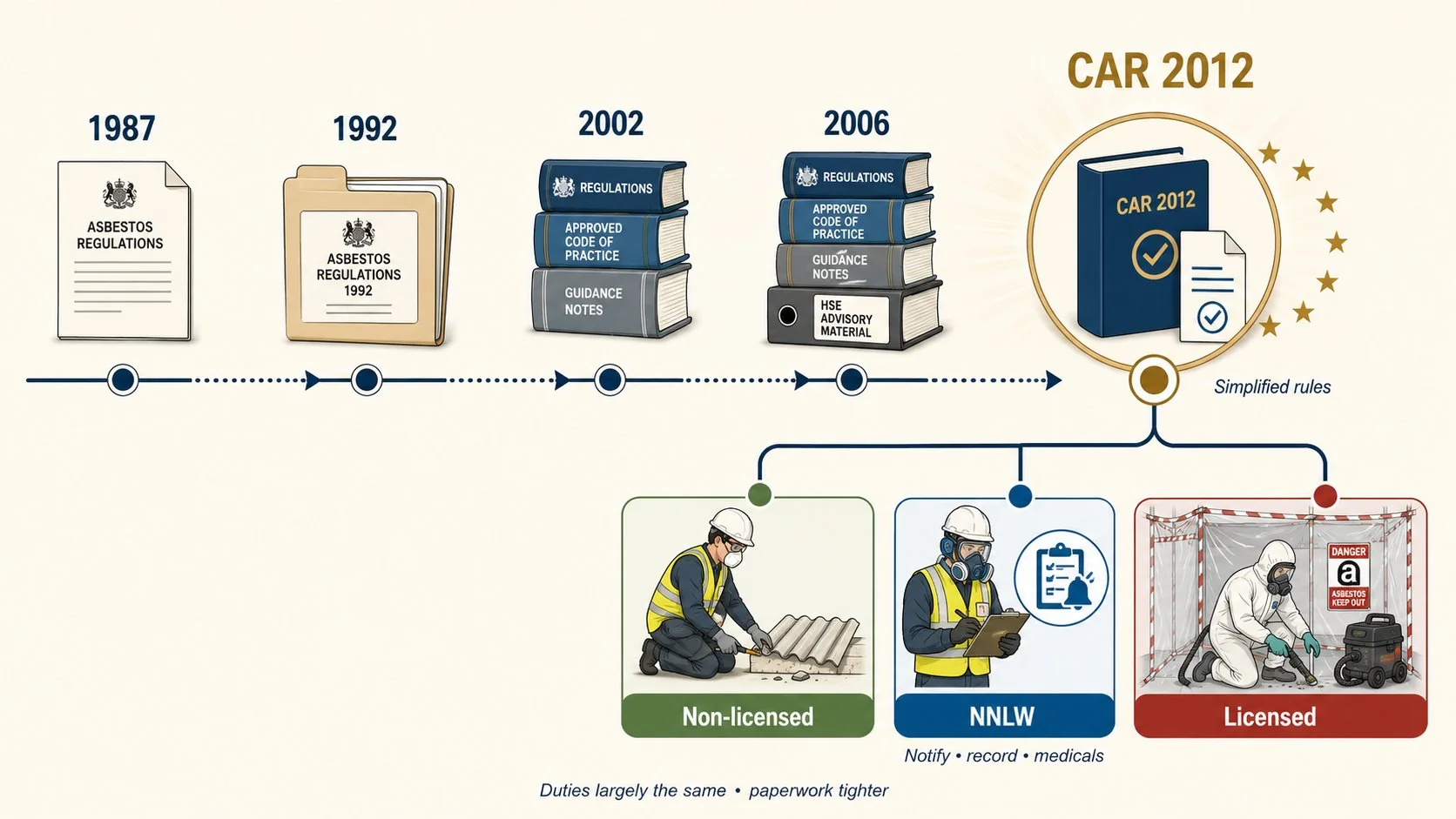
The 2012 regulations did not introduce a fundamentally new framework. They replaced the 2006 regulations primarily to address concerns raised by the European Commission that the UK had not fully transposed the EU Directive on the protection of workers from the risks related to exposure to asbestos at work. The substantive changes were modest — notifications for some non-licensed work, tighter medical surveillance requirements, and clearer training duties.
The main duties include managing asbestos in non-domestic premises (regulation 4), identification and assessment before work (5 and 6), plans of work (7), licensing and notification (8 and 9), training (10), exposure prevention and control (11 onwards), and health records and medical surveillance (22). Regulation 19 concerns air monitoring, not licensing.
Why CAR 2012 replaced the earlier regulations
The Control of Asbestos at Work Regulations had existed in various forms since 1987. By the late 2000s the framework had become layered: the 1987 regulations, the 1992 amendments, the 2002 update, the 2006 consolidation. CAR 2012 simplified the picture, and crucially brought UK law more closely into line with the requirements of the EU Asbestos Directive.
The 2012 changes introduced additional requirements for some non-licensed work: notification, medical surveillance and health records. Whether work is NNLW depends on the task, material and condition, after establishing that it is not licensable; a simple area or time threshold is insufficient.
For most duty holders and employers, the day-to-day impact of moving from CAR 2006 to CAR 2012 was modest. The duties were largely the same; the paperwork tightened.
Who CAR 2012 applies to

CAR 2012 applies to:
- Employers whose employees might be exposed to asbestos at work
- Self-employed workers who could be exposed in their own work — the regulations apply the duties of both employer and employee
- Duty holders of non-domestic premises (Regulation 4)
- Employees themselves, who have a duty to cooperate with their employer’s controls
Regulation 4 does not apply inside individual private homes. Work undertaken by employers or self-employed contractors in a home can still fall under CAR 2012, and householders must also consider applicable waste and other requirements.
There is, however, a carve-in: the common parts of domestic premises — the stairwells, lifts, plant rooms, corridors, and shared service ducts of blocks of flats — are treated as non-domestic for the purposes of Regulation 4. Whoever has responsibility for the maintenance of those common parts (typically the freeholder, the managing agent, or the residents’ management company) is the duty holder for them.
Schools, hospitals, offices, shops, factories, warehouses, places of worship, leisure facilities — all non-domestic premises and all within scope.
Regulation 4: the duty to manage
Regulation 4 is the duty to manage asbestos in Great Britain’s non-domestic premises and relevant common parts. It applies according to maintenance or repair obligations and, where applicable, control of the premises.
The duty holder must:
- Take reasonable steps to find out whether asbestos is present, in what amount, where, and in what condition
- Presume that materials contain asbestos unless there is strong evidence that they don’t
- Make and keep an up-to-date record (the asbestos register) of the location and condition of asbestos or presumed asbestos
- Assess the risk of anyone being exposed to fibres from those materials
- Prepare a written plan (the asbestos management plan) setting out how the risks will be managed
- Take steps to monitor the condition of the materials, manage or remove them where necessary, and make sure that anyone liable to disturb them is properly informed
We cover Regulation 4 in detail in our guide to the duty to manage asbestos, which goes through the practical compliance pattern, the asbestos register, the management plan, and the question of who counts as the duty holder in different tenancy and ownership structures.
Regulation 5: identifying asbestos before work
Regulation 5 sits alongside Regulation 4 but applies in a different context. Where Regulation 4 is about ongoing management of premises, Regulation 5 is about what you must do before starting work that could disturb asbestos.
Before any work begins, the employer must:
- Identify, so far as is reasonably practicable, whether asbestos is liable to be present in the work area
- Determine the type and condition of any asbestos present
- Take account of the asbestos register and any survey information already held
- Where the information is insufficient for the task, obtain adequate investigation or presume asbestos and apply the appropriate precautions
A management survey supports normal occupation and foreseeable maintenance. Refurbishment or demolition needs information sufficient for the full work area, normally from a suitably scoped intrusive survey. Do not assume an old management report covers hidden materials affected by new work.
The two survey types and when each is required are covered in our guide to asbestos surveys.
Regulation 6: assessment of work
Regulation 6 requires the employer to make a written risk assessment before any work liable to expose employees to asbestos. The assessment must identify the type of asbestos, the nature and degree of exposure expected, the steps to control exposure, and the protective equipment required.
The risk assessment must be reviewed if there’s any change to the work, the methods, or the conditions. It feeds into the written plan of work that’s required for non-licensed and licensed asbestos jobs.
Regulation 10: information, instruction and training
Regulation 10 is the training duty, and it’s the regulation that most directly affects construction, maintenance, and refurbishment workers who don’t deliberately work with asbestos but might encounter it in the course of their normal jobs.
The regulation requires every employer to ensure that employees who are, or are liable to be, exposed to asbestos — or who supervise such employees — are given adequate information, instruction, and training. The training must be given at regular intervals, adapted to changes in the work, and provided in a way appropriate to the level of exposure risk.
HSE describes three training levels. Category A, B and C are commonly used industry labels rather than category names written into the regulations:
- Category A — Asbestos Awareness. For workers whose work could foreseeably disturb the fabric of a building but who are not deliberately working with asbestos. Examples include electricians, plumbers, joiners, decorators, and general maintenance staff.
- Non-licensable work training (often called Category B): for appropriately assessed work that meets the conditions for not requiring a licence. Workers need task-specific competence and controls; the training label is not blanket permission to drill, cut or remove asbestos.
- Licensable work training (often called Category C): for work requiring a licensed contractor. The decision depends on all relevant material, exposure, task and duration criteria; neither a short duration nor a training certificate alone removes the licensing requirement.

There’s persistent confusion about how often asbestos awareness training has to be refreshed. The HSE’s own position, set out clearly on the HSE training page, is that there is no legal requirement to repeat an entire formal awareness refresher course every 12 months. What’s required is an appropriate update “as necessary” — which can be a toolbox talk, an e-learning module, or a periodic in-house briefing. Many providers market 12-monthly refreshers, and that frequency is sensible for many employers, but the legal duty is not specifically annual.
Our guide to who needs asbestos awareness training covers the trades and roles in scope and the refresher question in more depth.
Regulation 22: medical surveillance
For licensable work, medical examinations are carried out by an HSE-appointed doctor before exposure and at intervals not exceeding two years. For NNLW, examinations are required before starting and at least every three years while that work continues. There is no current generic “action level” trigger for this distinction.
The medical-surveillance and health-record duties apply to licensed work and NNLW. Other non-licensed work is exempt only where all the relevant conditions are met; the assessment must establish the correct category.
The employer’s health record must be retained for at least 40 years from the last entry. This is distinct from the doctor’s clinical notes and from the certificate confirming an examination.
The three categories of asbestos work

CAR 2012 divides asbestos work into three categories based on risk:
Licensable work includes higher-risk activities defined by the regulations. Exposure intensity, the control limit, the material and the full task all matter. Short duration alone does not exempt work from licensing.
NNLW is non-licensed work requiring notification before it begins, medical examinations and health records. Examples can include specified short-duration AIB removal, removal of asbestos-paper-backed flooring and substantial breakdown of certain bonded materials; assess the actual conditions.
Other non-licensed work still requires appropriate assessment, training and controls. Some carefully controlled work on cement, bonded tiles or textured coatings can fall here; neither a small area nor a familiar product automatically establishes the category.
The boundary between these categories is set out in the Approved Code of Practice L143 and in HSE guidance documents HSG247 (the licensed contractors’ guide) and HSG264 (the asbestos survey guide). Getting the category right is the contractor’s responsibility, and getting it wrong is a common route to enforcement action.
Penalties for non-compliance
Breaches can lead to prosecution, fines and, for offences where the law provides it, imprisonment. Maximum sentences depend on the offence, court and jurisdiction; do not assume one summary-court limit applies across Great Britain.
Inspectors can require improvements or prohibit dangerous work, and serious failings can be prosecuted. Pre-work identification, communication and effective controls matter even where no disease has yet been diagnosed.
The other consequence — sometimes more significant than the criminal penalty — is civil liability. Workers who develop asbestos-related disease decades after exposure can bring civil claims against the employer responsible for the exposure. The latency period of mesothelioma and asbestosis means that the employer paying out today may be paying for failures from many years earlier.
Frequently asked questions
Does CAR 2012 apply to private homes?
The duty to manage under regulation 4 does not apply inside individual private homes. Employers and self-employed contractors working there can still have CAR duties, and common parts of multi-occupancy domestic premises are within regulation 4.
What is the difference between Regulation 4 and Regulation 5?
Regulation 4 is the ongoing duty to manage asbestos in non-domestic premises — the register, the management plan, the routine inspections. Regulation 5 is the pre-work duty to identify asbestos before starting any work that might disturb it. The two interact: a refurbishment survey under Regulation 5 may update the Regulation 4 register.
Who is the duty holder under Regulation 4?
Whoever has responsibility for the maintenance or repair of the non-domestic premises, by virtue of a contract or tenancy. In a fully-repairing-and-insuring lease, that’s usually the tenant. In a simple occupation lease, it’s usually the landlord. In a shared building, more than one party can be a duty holder for different parts.
Do self-employed contractors fall under CAR 2012?
Yes. CAR 2012 applies the duties of both employer and employee to self-employed workers in relation to their own work. A self-employed plumber working on a pre-2000 commercial building is bound by the same identification, training, and control duties as if they were employed.
Can you go to prison for breaching CAR 2012?
Imprisonment is possible for certain health-and-safety offences. The available sentence depends on the offence, court and jurisdiction, as well as the facts of the case.
Does CAR 2012 require annual training?
For awareness, HSE says a whole formal refresher course is not legally required every 12 months; refresh knowledge as necessary. For licensable and non-licensable asbestos work, HSE advises refresher information and training annually, or sooner when needed.
How often must the asbestos register be updated?
Keep records current whenever circumstances change. HSE says to review the management plan every 12 months or sooner if needed, and set condition-monitoring arrangements for the actual risks.
Does CAR 2012 require you to remove asbestos?
There is no blanket requirement to remove all asbestos. Good-condition materials unlikely to be disturbed can often be managed in place. Damaged or at-risk materials need appropriate repair, protection, sealing or removal, and planned work may require removal.
CAR 2012 brings together major asbestos duties in Great Britain. Apply it alongside relevant construction, chemical and waste law, and use the separate Northern Ireland provisions for premises and work there.
For employers and supervisors who need to meet the Regulation 10 training duty for staff whose work could foreseeably disturb asbestos, our CPD-accredited Asbestos Awareness Course covers the syllabus set out in the Approved Code of Practice L143.
Related guides
- The duty to manage asbestos: registers, plans, and what Regulation 4 requires
- Types of asbestos surveys: management, refurbishment, and demolition explained
- Who needs asbestos awareness training?
Sources & references
- Great Britain — CAR 2012
- Northern Ireland — CAR 2012
- HSE L143 — approved code and guidance
- HSE — duty to manage
- HSE — information, instruction and training
- HSE — NNLW, examinations and health records
- HSE — licensing criteria
- HSE HSG264 — survey purposes and scope
Make sure your team meets the Regulation 10 training duty under CAR 2012.
Explore the Asbestos Awareness Course →
Mark writes about workplace health & safety, asbestos awareness and accredited online training for Asbestos Awareness Course, part of Online CPD Academy.