

The dates differ between Great Britain and Northern Ireland. In Great Britain, the blue/brown asbestos prohibition took effect on 1 January 1986 under the 1985 regulations, other amphiboles followed from 1 January 1993, and the main chrysotile prohibition took effect on 24 November 1999. Northern Ireland’s corresponding blue/brown and chrysotile dates were 6 March 1986 and 2 May 2000. Existing materials did not all have to be removed.
This guide sets out the legislation by year, explains why the ban happened in stages, and looks at what the dates mean in practice for properties and workers in the UK today.
The main asbestos-law milestones
Asbestos controls developed before the prohibitions, including the 1931 industry regulations and later workplace legislation. The timeline below focuses mainly on Great Britain; Northern Ireland made separate instruments.

The headline dates you need to know are these:
- 1931 — the Asbestos Industry Regulations introduced workplace dust controls, the first specific UK asbestos legislation.
- 1969 — the Asbestos Regulations extended workplace precautions
- 1985/86 — Great Britain’s blue/brown prohibition regulations took effect on 1 January 1986
- 1986 — Northern Ireland’s separate blue/brown provisions took effect on 6 March
- 1987/88 — workplace asbestos-control regulations strengthened continuing duties around exposure
- 1992/93 — the GB prohibition regime extended to the other amphiboles from 1 January 1993
- 1999/2000 — the main chrysotile prohibition took effect in Great Britain on 24 November 1999 and Northern Ireland on 2 May 2000
- 2002 — the Control of Asbestos at Work Regulations 2002 strengthened post-ban management duties.
- 2006 — the Control of Asbestos Regulations 2006 consolidated the various pieces of asbestos law into a single regulatory framework.
- 2012 — separate Great Britain and Northern Ireland asbestos regulations replaced their earlier workplace regimes
The 1985 ban: blue and brown asbestos
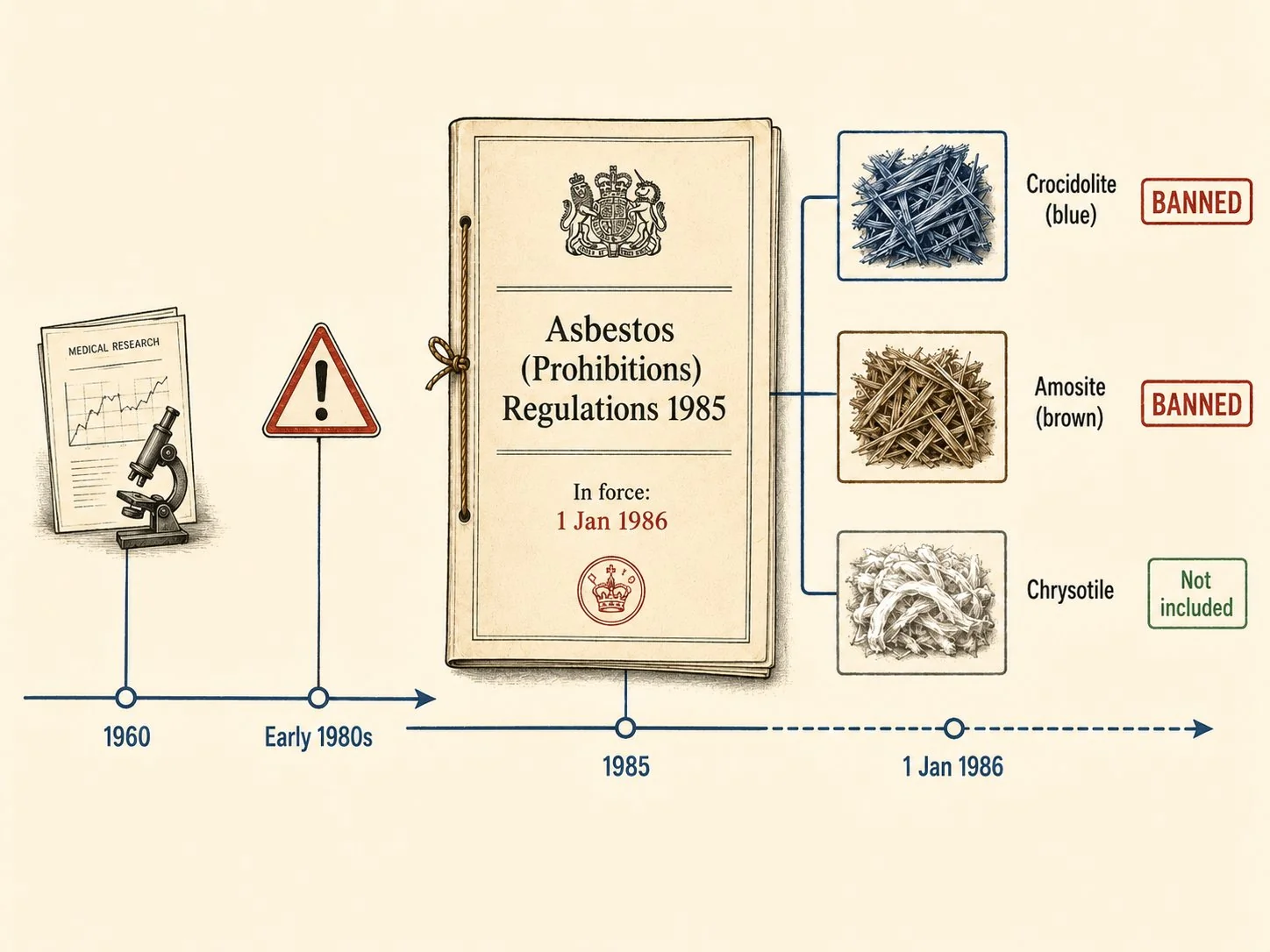
By the early 1980s the disease pattern associated with crocidolite and amosite was unambiguous. Mesothelioma had been linked to crocidolite exposure since Christopher Wagner's 1960 paper on South African asbestos miners, and the latency period meant that workers exposed in the 1950s and 60s were now reaching diagnosis in numbers that could no longer be discounted as anomalous.
The Asbestos (Prohibitions) Regulations 1985 introduced the Great Britain blue/brown restrictions from 1 January 1986. Northern Ireland followed through its own 1986 instrument from 6 March. The year a regulation was made is not necessarily its commencement date.
Chrysotile was not covered by the same initial general prohibition. The later GB stages covered the other amphiboles from 1993 and chrysotile from November 1999; all types are now recognised as carcinogenic.
The 1999 ban: white asbestos and the full prohibition
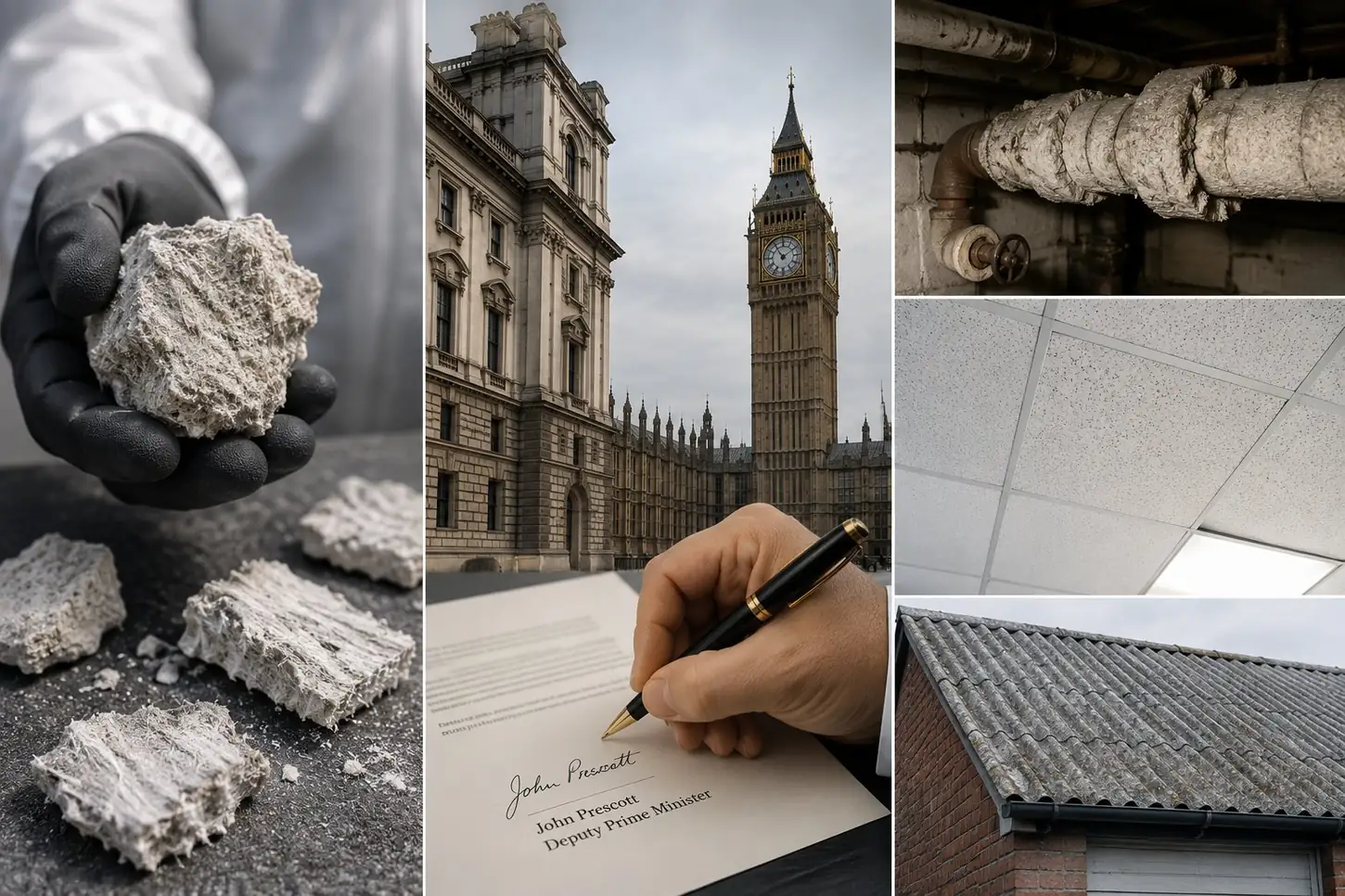
Through the 1990s the controlled-use position became harder to defend. Studies continued to link chrysotile exposure to mesothelioma, asbestosis, and lung cancer. The European Commission moved toward a continent-wide ban. Trade-policy disputes — including a challenge by Canada to French chrysotile restrictions at the World Trade Organisation — concentrated minds on the regulatory question.
Great Britain’s 1999 amendment introduced the main chrysotile prohibition from 24 November 1999. Northern Ireland made a separate amendment commencing on 2 May 2000. These dates should not be collapsed into one UK-wide commencement date.
The 1999 amendment did not require existing asbestos materials to be removed. Anything already in place — pipe lagging in a hospital basement, AIB ceiling tiles in an office block, asbestos cement on a garage roof — could remain, provided it was managed safely. That principle still governs UK asbestos law today: identify, presume, register, assess, manage, and only remove where it's appropriate.
Why was the ban so slow?

Two reasons, both worth understanding because they shape how UK buildings ended up the way they did.
The first is that the dangers of asbestos were known in stages, not all at once. The Asbestos Industry Regulations 1931 followed a Home Office inquiry into asbestosis among textile workers — meaning that by 1931 the UK government already knew asbestos could kill. What wasn't known with certainty until much later was the long latency period for mesothelioma, the carcinogenic effect at lower exposures, and the distinct risks of the different mineral types. Each new piece of evidence triggered a regulatory step rather than an outright ban.
Asbestos had useful heat-resistant and reinforcing properties and was widely used in industry and construction. The long-lived products explain why a ban on new use did not immediately eliminate asbestos from buildings.
The cumulative effect is that anything built or refurbished in the UK between roughly 1930 and the late 1990s could contain asbestos somewhere in its fabric — and a significant proportion of British buildings of that era do.
Why pre-2000 buildings still matter
HSE uses construction before 2000 as a practical warning that asbestos may be present. It is not proof that every older product contains asbestos or that every later building is asbestos-free: retained older parts, records and the actual work area matter.
Where there is insufficient evidence, presume suspected materials contain asbestos and apply the appropriate precautions. Relevant duties include ongoing management and identification before work; a building’s date alone is not a survey.
You can read more about how these duties work in our guide to the Control of Asbestos Regulations 2012 and the duty to manage asbestos.
Where asbestos is still legal in 2026
Asbestos is not banned everywhere. WHO’s August 2026 fact sheet reports that more than 50 Member States have prohibited its use. Rules, exemptions and implementation dates differ by jurisdiction:
- European Union — the 1999 directive set a 1 January 2005 implementation deadline for the chrysotile restrictions, with specified provisions and exceptions
- Great Britain — the main chrysotile prohibition took effect on 24 November 1999
- Northern Ireland — the corresponding chrysotile amendment took effect on 2 May 2000
- United States — EPA’s 2024 chrysotile rule has use-specific transition periods; it should not be described as an immediate universal ban on every legacy asbestos material
- Current mining — USGS lists Russia, China, Kazakhstan and Brazil in its 2025 production estimates; mining or export does not prove domestic use is unrestricted

USGS estimates show continuing asbestos production outside the UK. Mining, consumption and legal restrictions measure different things, so a production table cannot be read as a list of countries with unrestricted asbestos use.
Frequently asked questions
Was asbestos banned in the UK in 1999 or 2000?
For Great Britain, the main chrysotile prohibition began on 24 November 1999. Northern Ireland’s corresponding amendment began on 2 May 2000. HSE’s pre-2000 building guidance is a practical precaution, not a substitute for the exact legal dates.
Was asbestos banned in 1985 or 1999?
Restrictions were phased. Great Britain’s blue/brown rules began in 1986 under the 1985 instrument; other amphiboles followed in 1993 and chrysotile in November 1999. Northern Ireland used separate legislation.
Why was white asbestos legal until 1999 when blue and brown were banned in 1985?
Chrysotile was treated differently during the development of the restrictions, but all forms are carcinogenic. The staged history does not make past chrysotile use safe or exempt existing materials from management.
Is asbestos still legal anywhere?
Some countries continue to mine or use asbestos. USGS’s 2025 production table lists four producing countries, while WHO reports more than 50 Member States with use bans. Check the relevant jurisdiction and use rather than assume mining and domestic-use rules are identical.
When was the EU-wide asbestos ban?
The EU’s 1999 chrysotile directive required implementation by 1 January 2005, with specified provisions and exceptions. Great Britain and Northern Ireland implemented their main restrictions earlier, on different dates.
Could a house built in 1995 contain asbestos?
Yes. A 1995 property may contain asbestos in its original materials or later alterations. Establish what is present before work that could disturb it; appearance and building age are not conclusive.
Are there any exemptions to the 1999 ban?
The historical legislation contained specified exceptions and transitional provisions. Do not assume a historic exception permits a new construction or consumer use today; check the current applicable chemical restrictions.
For more on the materials these regulations were created to control, see our reference guide to asbestos-containing materials in UK buildings and our practical guide to recognising asbestos. For workers in the construction and maintenance trades whose work could foreseeably disturb asbestos in a pre-2000 building, training is mandatory under Regulation 10 — our Asbestos Awareness Course covers the syllabus required.
Related guides
- The Control of Asbestos Regulations 2012
- The duty to manage asbestos: registers, plans, and what Regulation 4 requires
- Asbestos-containing materials in UK buildings: a reference guide
Sources & references
- Historical GB regulations — separate prohibition dates
- Northern Ireland — 1986 blue/brown prohibition
- Northern Ireland — 2000 chrysotile amendment
- WHO — asbestos use bans, August 2026
- USGS 2026 — world mine production
- European Commission — 1999 chrysotile directive
- US EPA — chrysotile rule and transition periods
- HSE — older buildings and asbestos identification
Make sure your team can recognise asbestos and knows what to do.
Explore the Asbestos Awareness Course →
Mark writes about workplace health & safety, asbestos awareness and accredited online training for Asbestos Awareness Course, part of Online CPD Academy.