
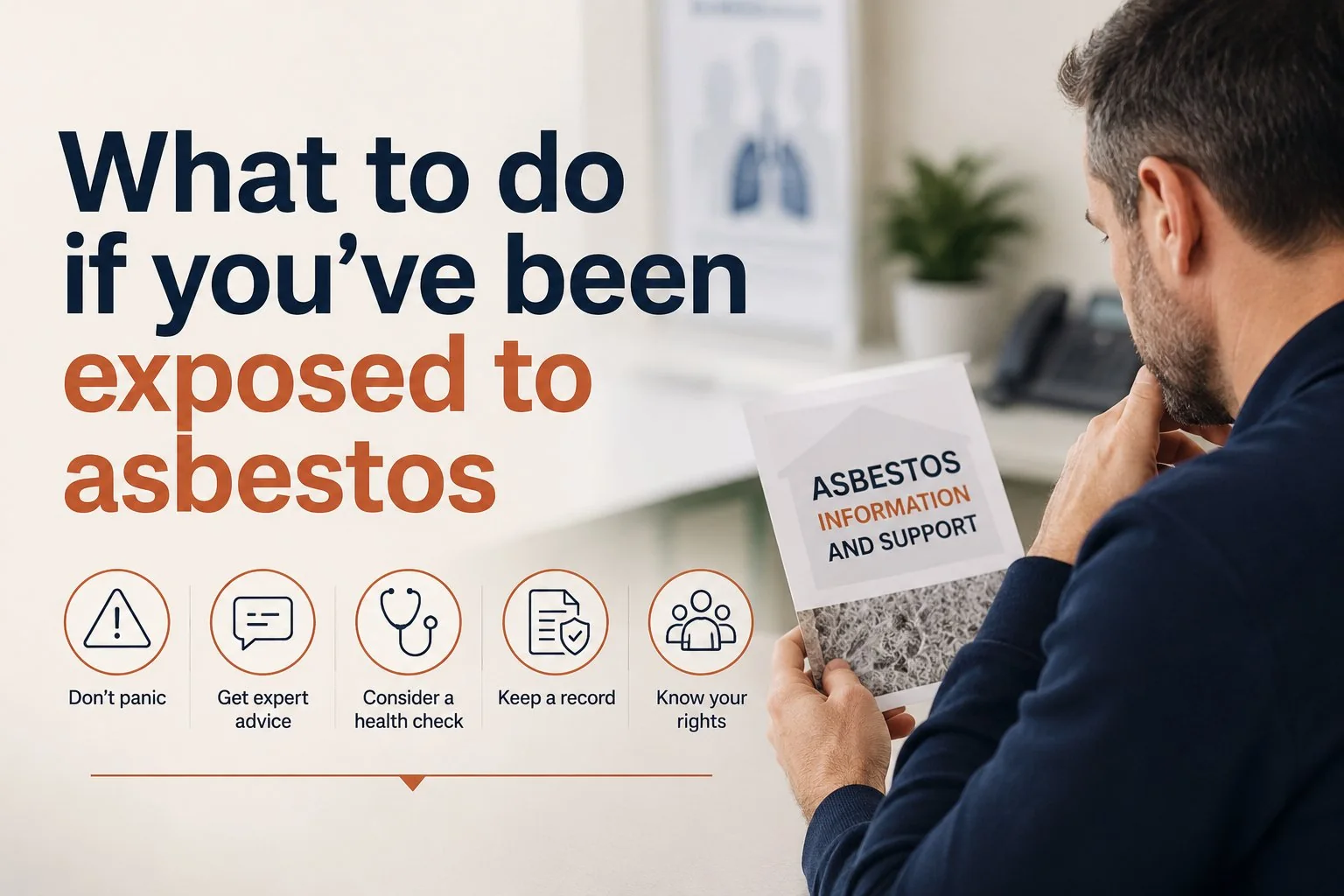
If you discover or accidentally disturb suspected asbestos, stop work and get help. The response must prevent further exposure and avoid spreading contamination. Follow the workplace emergency arrangements and HSE’s EM1 guidance; a short web checklist cannot replace the assessment of the incident.
An accidental exposure does not mean that disease will develop. The likely risk depends on the material, airborne concentration and exposure, which cannot be judged from duration or symptoms alone. Prevent further exposure and record what happened.
The immediate steps

If you've just disturbed something you suspect is asbestos:
1. Stop work immediately. Don't continue. Don't try to clean up. Don't try to make the situation better by tidying. Any further activity in the area is likely to release more fibres.
2. Warn people and prevent further exposure. People without suitable protection should leave the affected area while contamination is controlled to minimise its spread. Do not walk through clean areas in contaminated clothing or travel home to deal with it.
3. Get help with contamination before moving it elsewhere. For heavily contaminated clothing, hair or footwear, HSE EM1 gives a specific procedure: avoid spreading dust, seek protected assistance and deal with contaminated outer clothing before moving away. Do not improvise a clean-up or put yourself at further risk.
4. Keep other people out. Warn the person in charge, restrict access and follow the incident plan. Do not re-enter an affected area simply to put up tape or close windows.
5. Do not brush or shake contaminated clothing. HSE’s procedure uses controlled damp wiping for minor contamination and suitable assistance for substantial contamination. Ordinary vacuum cleaners and dry sweeping can spread fibres.
6. Contain contaminated items before washing. Under the incident procedure, contaminated clothing and cleaning materials are bagged for appropriate asbestos-waste disposal. Washing hair or showering is considered after contamination has been controlled; a trip home in dusty clothing is not decontamination.
7. Report and arrange competent assessment. At work, notify the supervisor or person in charge immediately. At home, keep people away and seek competent asbestos advice. Sampling, clean-up and any required licensed work must be arranged safely.
What NOT to do

Some things make the situation worse:
- Do not sweep or use an ordinary vacuum cleaner. Appropriate Class H equipment and controlled methods are for competent, trained personnel; owning a suitable vacuum does not make someone qualified to clean asbestos contamination.
- Don't dry-brush yourself or your clothes. It releases fibres back into the air at the point where you'd most want to avoid it.
- Don't continue working until the area is cleared. Even if you've finished cleaning yourself up, the room or area you disturbed is still potentially contaminated until properly decontaminated by competent personnel.
- Don't take your work clothes home. Particularly if you live with children or other vulnerable family members. Secondary exposure through household laundry is one of the well-documented pathways for take-home asbestos disease.
- Do not dismiss urgent symptoms. Possible asbestos exposure alone does not normally require emergency treatment, but severe breathing difficulty, serious injury or another medical emergency needs urgent help. Tell healthcare staff about possible contamination.
- Keep a factual record of the event and notify the employer where applicable. If concerned about possible exposure, consult your GP and ask for the circumstances to be recorded.
Decontamination — yourself, your clothes, the area
For the person who's been exposed:
- Follow the incident procedure for the level of contamination; minor dust and heavily contaminated clothing require different responses
- Obtain suitably protected help for substantial contamination; do not spread dust through clean areas
- Contain contaminated clothing and cleaning materials as asbestos waste before considering hair washing or showering
- Do not rely on coughing, blowing your nose or washing to reverse inhalation; obtain medical advice about any symptoms or concerns

For the clothing:
- Disposable clothing (overalls, coveralls) used during the disturbance should be disposed of as asbestos waste, not laundered
- Do not decide that suspected contaminated work clothing can go in household laundry; arrange specialist handling through the incident plan
- Do not put suspected-contaminated clothing in the household laundry where it can transfer fibres to other items

For the area itself:
- Clean-up must be planned and carried out by people with the competence, training, equipment and controls appropriate to the contamination. This is determined by their capability and the work involved, not by who caused the disturbance.
- Routine cleaning equipment is not adequate
- For a workplace incident, the duty holder or employer arranges decontamination through a competent contractor
- For a domestic incident, arrange competent advice on assessment and clean-up; avoid further disturbance while awaiting it

Reporting — workplace versus home
The reporting requirements depend on where the exposure happened.
At work, the chain of events is:
- Tell your supervisor or employer immediately
- The employer must consider RIDDOR reporting. An accidental release that could cause sufficient exposure to damage health can be a dangerous occurrence; not every discovery of intact asbestos is reportable.
- The asbestos management plan for the premises should specify the emergency response — follow it
- Keep a factual incident and potential-exposure record, including people affected, dates, material and actions taken
At home or in a private domestic setting:
- Stop work and isolate the area
- Arrange competent sampling and analysis if needed, or manage the material as presumed asbestos with appropriate controls; do not take an improvised sample
- If asbestos is confirmed and the disturbance was significant, contact your local council's environmental health team — they can advise on safe management and disposal
- Document what happened, including dates, the material involved, and what you did
In a public or commercial building you don't own:
- Report immediately to the building manager, duty holder, or facilities lead
- The person responsible for the premises and the employer must arrange the response under the applicable duties. CAR 2012 applies in Great Britain; Northern Ireland has separate regulations.
- Make sure you receive a written acknowledgement of your report — this is your record for any future medical or legal need
Telling your GP
If concerned about possible exposure, consult your GP and ask for a note in your medical record. Also follow the workplace reporting and contamination-control procedures.
Asbestos-related diseases usually take many years to develop. Recording the circumstances helps future clinicians assess symptoms, but does not itself diagnose exposure or predict disease.
Tell the GP:
- When the exposure happened
- What the material was (suspected or confirmed)
- The circumstances — workplace, home, public building
- Whether any test results are available
- Whether protective equipment was being worn
A GP can discuss the exposure and any symptoms and decide whether specialist assessment is needed. HSE does not recommend routine X-rays after inadvertent exposure: an X-ray cannot establish how many fibres were inhaled.
Was it actually asbestos? Getting the material tested
Until you've had a sample tested, you don't know whether the disturbance involved asbestos at all. In a pre-2000 UK building, the cautious default is to presume asbestos until shown otherwise — but the actual answer comes from the lab, not from visual identification.
At work, the employer must arrange a competent assessment of the incident and the precautions needed. This may include appropriate sampling and analysis, or treating the material as presumed asbestos and applying the corresponding controls.
Use a competent asbestos surveyor or sampling professional and a laboratory accredited for asbestos identification. A sample result applies to the material sampled; do not disturb suspected material just to obtain a sample yourself.
If the test confirms asbestos, the situation moves into management mode — decontamination, removal where necessary, addition to the asbestos register if it's a non-domestic premises.
If the test rules out asbestos, document the result, file it, and update any management records that referenced the material as "presumed". A clean test result is itself useful evidence.
What if it was a single brief exposure?
A brief, accidental exposure will often involve a lower dose than prolonged occupational exposure, but the duration alone cannot establish the dose or an individual outcome. Prevent further exposure and seek advice if concerned.
There is no established safe exposure threshold. That does not mean every exposure causes illness; it means the incident should be assessed and controlled rather than dismissed from its apparent size.
The appropriate response is to stop work, warn others, control contamination, obtain competent help and record the incident. Discuss possible exposure with your GP if concerned.
Frequently asked questions
What should I do right after disturbing asbestos?
Stop work, warn others and call the person in charge. Prevent further exposure while avoiding the spread of contamination; follow HSE EM1 and obtain suitably protected help for contaminated clothing or substantial dust. Keep others away and arrange competent assessment.
Do I need to tell my GP?
If concerned about possible exposure, consult your GP and ask for its date, duration, material and circumstances to be recorded. Routine X-rays are not recommended after inadvertent exposure.
Is one-off exposure dangerous?
Risk depends on the airborne dose and other factors, not simply whether the event happened once. Many accidental short exposures are low risk, but no individual outcome can be predicted from that description alone.
How do I clean asbestos off my clothes?
Do not brush, shake or use an ordinary vacuum. Follow the contamination procedure in HSE EM1, obtaining suitably protected assistance where needed. Contain contaminated items for appropriate handling; do not put them in household laundry.
Should I report the exposure to anyone official?
At work, yes — tell your employer, who must consider whether the incident is reportable under RIDDOR as a dangerous occurrence. In a public building, tell the duty holder. At home, document it for your own record and engage an asbestos surveyor.
Can I shower at home after exposure?
Do not travel home in contaminated clothing or spread dust through your home. Control contamination at the incident, obtain appropriate help and contain contaminated items first; the procedure then considers hair washing and showering.
Will I get asbestos disease from one exposure?
No one can predict that from the fact of one exposure. Dose, fibre type and other circumstances matter. Prevent further exposure, record the incident and discuss concerns with your GP.
For more on the diseases asbestos can cause and the latency periods involved, see our page on asbestos exposure, symptoms, and the timeline of harm. For the wider context of how asbestos is regulated in the UK and what the legal duties are, see our guide to asbestos awareness in the UK and the Control of Asbestos Regulations 2012.
For workers and supervisors whose work in pre-2000 UK buildings means accidental exposure is a foreseeable risk, our CPD-accredited Asbestos Awareness Course covers the syllabus required under Regulation 10 — including the emergency procedures to follow if asbestos is disturbed.
Related guides
- Asbestos exposure and symptoms: the timeline of harm
- The Control of Asbestos Regulations 2012
- The duty to manage asbestos: registers, plans, and Regulation 4
Sources & references
- HSE EM1 — discovery, accidental release and contamination response
- HSE — accidental exposure, GP records and RIDDOR
- UKHSA — asbestos exposure and health
- NHS — symptoms requiring urgent medical help
- Great Britain — Control of Asbestos Regulations 2012
- Northern Ireland — Control of Asbestos Regulations 2012
Make sure your team knows what to do if asbestos is disturbed.
Explore the Asbestos Awareness Course →
Mark writes about workplace health & safety, asbestos awareness and accredited online training for Asbestos Awareness Course, part of Online CPD Academy.